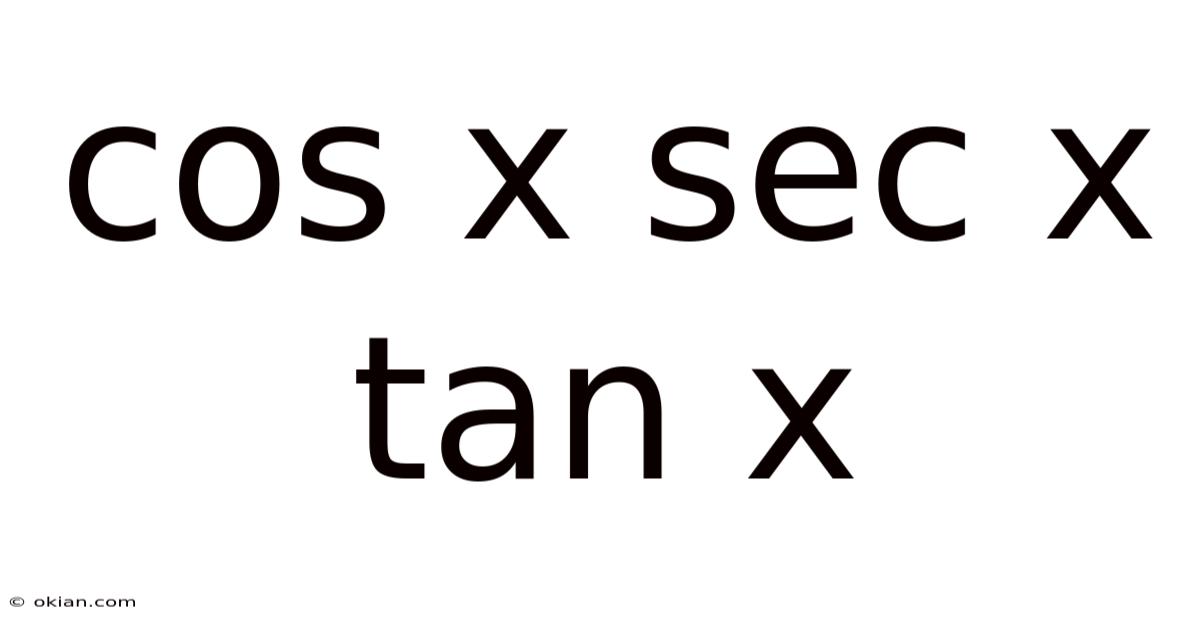
Introduction
When you first encounter the trigonometric trio cos x, sec x, and tan x, they may look like a random assortment of symbols on a page. In reality, they are tightly interconnected functions that form the backbone of many problems in calculus, physics, engineering, and even computer graphics. That's why this article unpacks the meaning of each function, shows how they relate to one another, and walks you through practical ways to manipulate expressions that involve cos x · sec x · tan x. By the end, you’ll be able to simplify, differentiate, integrate, and apply this product confidently—whether you’re solving a high‑school exam question or modeling a real‑world system Most people skip this — try not to..
Detailed Explanation
The three basic functions
-
Cosine (cos x) – The ratio of the adjacent side to the hypotenuse in a right‑angled triangle, or the x‑coordinate of a point on the unit circle at angle x. Its graph is a smooth wave ranging between –1 and 1, with a period of (2\pi).
-
Secant (sec x) – Defined as the reciprocal of cosine:
[ \sec x = \frac{1}{\cos x} ]
Because it is a reciprocal, secant is undefined wherever cosine equals zero (i.e., at odd multiples of (\frac{\pi}{2})). Its graph consists of alternating branches that stretch toward positive or negative infinity The details matter here.. -
Tangent (tan x) – The ratio of sine to cosine:
[ \tan x = \frac{\sin x}{\cos x} ]
Tangent measures the slope of the line formed by the radius that makes an angle x with the positive x‑axis. Like secant, it has vertical asymptotes where cosine is zero.
Why the product matters
The expression cos x · sec x · tan x may initially appear complicated, but notice that cos x and sec x are exact reciprocals. Multiplying them together instantly simplifies the product:
[ \cos x \times \sec x = \cos x \times \frac{1}{\cos x} = 1 \quad (\text{provided } \cos x \neq 0) ]
Because of this, the whole expression collapses to just tan x (again, with the same domain restriction). This simple observation is a cornerstone of many algebraic tricks in trigonometry, allowing you to reduce seemingly messy formulas to something manageable.
Domain and restrictions
Even though the algebraic simplification yields (\tan x), the original product inherits the most restrictive domain of its factors. Both sec x and tan x are undefined when (\cos x = 0); therefore, the product is defined only for angles where (\cos x \neq 0). In interval notation:
[ x \neq \frac{\pi}{2} + k\pi,\qquad k\in\mathbb{Z} ]
Remembering this restriction prevents accidental division by zero when you later differentiate or integrate the expression.
Step‑by‑Step or Concept Breakdown
1. Simplify the product
| Step | Operation | Reason |
|---|---|---|
| A | Write each function in its definition | (\cos x) stays, (\sec x = 1/\cos x), (\tan x = \sin x / \cos x) |
| B | Multiply (\cos x) and (\sec x) | (\cos x \times \frac{1}{\cos x}=1) |
| C | Multiply the result by (\tan x) | (1 \times \tan x = \tan x) |
| D | State domain | Exclude points where (\cos x = 0) |
Result:
[ \boxed{\cos x , \sec x , \tan x = \tan x \quad \text{for } x \neq \frac{\pi}{2}+k\pi} ]
2. Differentiate the simplified form
If you need (\frac{d}{dx}\big(\cos x \sec x \tan x\big)), differentiate (\tan x) directly:
[ \frac{d}{dx}\tan x = \sec^{2}x ]
Thus
[ \frac{d}{dx}\big(\cos x \sec x \tan x\big)=\sec^{2}x,\qquad x\neq\frac{\pi}{2}+k\pi ]
3. Integrate the product
Similarly, the integral becomes the integral of (\tan x):
[ \int \cos x \sec x \tan x ,dx = \int \tan x ,dx = -\ln|\cos x| + C ]
The logarithmic result follows from the standard antiderivative (\int \tan x ,dx = -\ln|\cos x|+C).
4. Verify with a numeric example
Take (x = \frac{\pi}{4}).
- (\cos\frac{\pi}{4}= \frac{\sqrt{2}}{2})
- (\sec\frac{\pi}{4}= \frac{2}{\sqrt{2}} = \frac{\sqrt{2}}{1})
- (\tan\frac{\pi}{4}=1)
Product: (\frac{\sqrt{2}}{2}\times\sqrt{2}\times1 = 1).
(\tan\frac{\pi}{4}=1) as expected. This quick check confirms the simplification works for any valid angle.
Real Examples
Example 1: Solving a trigonometric equation
Suppose you need to solve
[ \cos x \sec x \tan x = 2 ]
Using the simplification, the equation reduces to (\tan x = 2). The solutions are
[ x = \arctan 2 + k\pi,\qquad k\in\mathbb{Z} ]
No extra work is required to handle the original product, and the domain restriction is automatically satisfied because (\tan 2) is defined.
Example 2: Physics – Projectile motion
In projectile motion, the horizontal component of velocity is (v_{x}=v\cos\theta) and the vertical component is (v_{y}=v\sin\theta). The ratio (v_{y}/v_{x} = \tan\theta) appears in many derivations (range, time of flight). If a textbook mistakenly writes the ratio as (\cos\theta \sec\theta \tan\theta), recognizing the simplification prevents confusion and saves time when deriving the range formula:
No fluff here — just what actually works.
[ R = \frac{v^{2}}{g}\sin 2\theta = \frac{v^{2}}{g},2\tan\theta\cos^{2}\theta ]
Replacing (\cos^{2}\theta) with (1/\sec^{2}\theta) and simplifying again yields the familiar expression. Understanding the relationship between these functions streamlines the algebra.
Example 3: Computer graphics – texture mapping
When mapping a texture onto a 3D surface, the UV‑coordinates often involve (\tan) of an angle derived from the surface normal. On the flip side, if a shader mistakenly multiplies (\cos), (\sec), and (\tan) together, the simplification to (\tan) reduces computational load dramatically, which is critical for real‑time rendering. The GPU can skip two extra floating‑point operations per pixel, leading to measurable performance gains in high‑resolution scenes Turns out it matters..
Scientific or Theoretical Perspective
Reciprocal identities and the unit circle
The identity (\sec x = 1/\cos x) is a direct consequence of defining trigonometric functions on the unit circle. Day to day, for a point ((\cos x, \sin x)) on the circle, the line from the origin to that point forms a right triangle with hypotenuse 1. The adjacent side equals (\cos x), so the length of the line segment extending from the point to the vertical line (x = 1) (the “secant line”) is (1/\cos x). This geometric interpretation underscores why secant is undefined when the adjacent side collapses to zero (i.e., at the top and bottom of the circle).
Derivative of tangent from first principles
Starting from (\tan x = \sin x / \cos x), apply the quotient rule:
[ \frac{d}{dx}\tan x = \frac{\cos x \cdot \cos x + \sin x \cdot \sin x}{\cos^{2}x} = \frac{\cos^{2}x + \sin^{2}x}{\cos^{2}x}= \frac{1}{\cos^{2}x}= \sec^{2}x ]
Here the Pythagorean identity (\sin^{2}x+\cos^{2}x=1) is essential. This derivation reveals why the derivative of the simplified product (\cos x\sec x\tan x) ends up as (\sec^{2}x).
Integral connection to logarithms
The antiderivative (\int \tan x ,dx = -\ln|\cos x| + C) emerges from rewriting (\tan x = \sin x / \cos x) and using substitution (u = \cos x). That said, the natural logarithm appears because the integral of (1/u) is (\ln|u|). This link illustrates how trigonometric integrals often translate into logarithmic forms, a fact exploited in solving differential equations involving trigonometric functions Still holds up..
Common Mistakes or Misunderstandings
-
Ignoring the domain restriction – Students often simplify (\cos x \sec x) to 1 and then claim the product equals (\tan x) for all real (x). The correct statement must exclude angles where (\cos x = 0); otherwise, you are implicitly dividing by zero Easy to understand, harder to ignore..
-
Confusing secant with cosine – Because “sec” sounds like “second”, beginners sometimes think (\sec x) is the second derivative of (\cos x). Reinforce that secant is the reciprocal, not a derivative.
-
Mismatched parentheses in calculators – Entering “cos x sec x tan x” without explicit multiplication symbols can lead calculators to interpret the expression as (\cos(x\cdot\sec(x)\cdot\tan(x))), which is a completely different function. Always use “*” or parentheses to indicate multiplication.
-
Assuming (\tan x) is always positive – Since the product reduces to (\tan x), its sign follows the quadrant of the angle. Remember that (\tan) is positive in the first and third quadrants and negative in the second and fourth, matching the original product’s sign It's one of those things that adds up..
FAQs
1. Is (\cos x \cdot \sec x \cdot \tan x) ever equal to zero?
No. After simplification the expression becomes (\tan x). Tangent is zero only when (\sin x = 0) and (\cos x \neq 0), i.e., at integer multiples of (\pi). At those points the original product is also zero because (\tan x = 0) while (\cos x) and (\sec x) are finite.
2. How does the product behave near the points where (\cos x = 0)?
As (x) approaches (\frac{\pi}{2}+k\pi), (\cos x) tends to zero, making (\sec x) blow up to (\pm\infty). Simultaneously, (\tan x) also tends to (\pm\infty). The product (\cos x \sec x) stays at 1, so the overall behavior mirrors that of (\tan x): it diverges to (\pm\infty) with the same sign as the cosine’s sign change Less friction, more output..
3. Can I use the identity in complex numbers?
Yes. The definitions (\cos z = \frac{e^{iz}+e^{-iz}}{2}) and (\sec z = 1/\cos z) hold for complex (z). The simplification (\cos z \sec z = 1) remains valid wherever (\cos z \neq 0). As a result, (\cos z \sec z \tan z = \tan z) for all complex (z) outside the zeros of cosine And that's really what it comes down to..
4. Why do textbooks sometimes write the product instead of just (\tan x)?
Often the product appears in intermediate steps of derivations, especially when starting from geometric definitions (e.g., using a right‑triangle where (\sec) and (\cos) arise naturally). Writing the full product makes the origin of each factor explicit, helping students see how reciprocal identities simplify the expression later.
Conclusion
The expression cos x · sec x · tan x is a textbook illustration of how reciprocal trigonometric identities can turn a seemingly tangled product into a single, familiar function. But by recognizing that (\cos x) and (\sec x) cancel each other, we reduce the whole expression to (\tan x), remembering to keep the domain restriction (x \neq \frac{\pi}{2}+k\pi). This simplification streamlines differentiation, integration, equation solving, and real‑world modeling across physics, engineering, and computer graphics.
Worth pausing on this one.
Understanding the underlying relationships—reciprocal definitions, Pythagorean identities, and the unit‑circle geometry—equips you with a powerful toolkit for tackling more complex trigonometric problems. Now, avoid common pitfalls such as ignoring domain restrictions, and you’ll be able to apply these concepts confidently in both academic work and practical applications. Mastery of this small but potent trio opens the door to deeper insights into the elegant world of trigonometry.
