Introduction
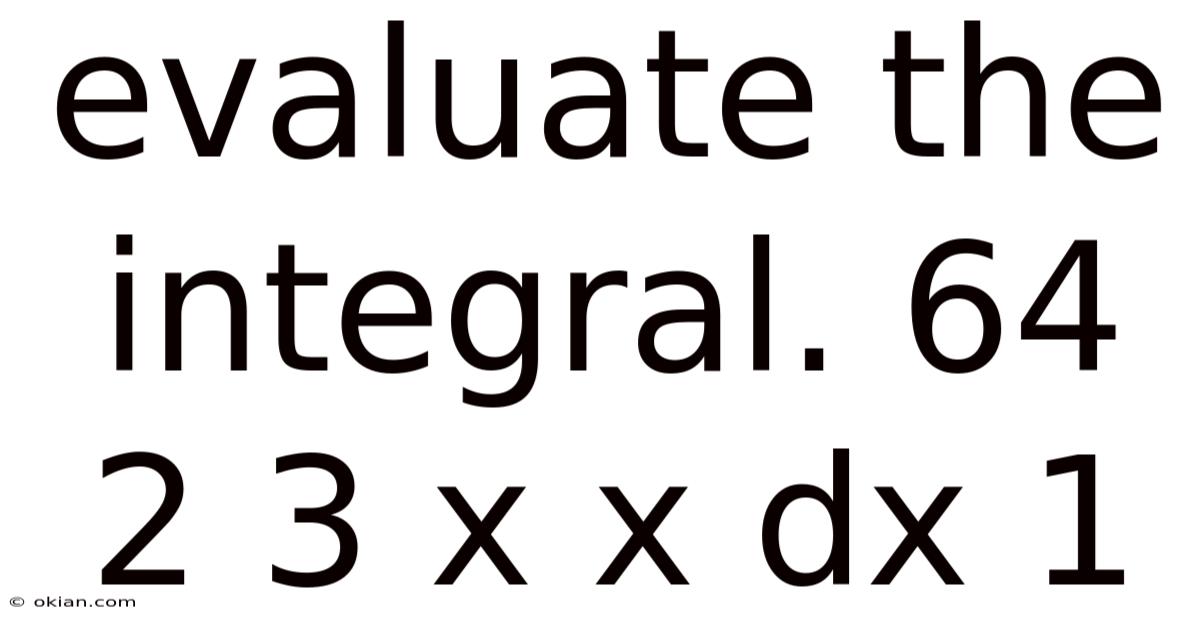
Evaluating the integral ∫₁² (64x² + 3x) dx is a fundamental exercise in calculus that demonstrates the application of integration techniques to compute the area under a curve. This problem involves integrating a polynomial function over a defined interval, which is a core concept in both differential calculus and integral calculus. By breaking down this integral into manageable steps, we can understand how to apply the Fundamental Theorem of Calculus to find the exact value of the definite integral.
Detailed Explanation
To evaluate the integral ∫₁² (64x² + 3x) dx, we first identify the components of the integrand. The function inside the integral, 64x² + 3x, is a polynomial composed of two terms: 64x² and 3x. Each term can be integrated separately using the power rule for integration, which states that the integral of xⁿ is (xⁿ⁺¹)/(n+1), provided n ≠ -1 That alone is useful..
For the first term, 64x², applying the power rule gives us (64/3)x³. For the second term, 3x, the integral is (3/2)x². Combining these results, the antiderivative of 64x² + 3x is (64/3)x³ + (3/2)x². That said, this antiderivative represents a family of functions whose derivative is the original integrand. The next step is to evaluate this antiderivative at the upper limit (x = 2) and the lower limit (x = 1), then subtract the two values to find the definite integral Small thing, real impact..
This process is grounded in the Fundamental Theorem of Calculus, which connects differentiation and integration. Now, specifically, the theorem states that if F(x) is an antiderivative of f(x), then the definite integral of f(x) from a to b is F(b) - F(a). This theorem is crucial because it allows us to compute definite integrals without resorting to the limit of a Riemann sum, which can be computationally intensive.
Step-by-Step or Concept Breakdown
To evaluate the integral ∫₁² (64x² + 3x) dx, we follow these steps:
-
Find the Antiderivative:
Integrate each term of the polynomial separately.- For 64x²: Apply the power rule to get (64/3)x³.
- For 3x: Apply the power rule to get (3/2)x².
The combined antiderivative is F(x) = (64/3)x³ + (3/2)x².
-
Evaluate at the Upper Limit (x = 2):
Substitute x = 2 into the antiderivative:
F(2) = (64/3)(2)³ + (3/2)(2)² = (64/3)(8) + (3/2)(4) = 512/3 + 6. -
Evaluate at the Lower Limit (x = 1):
Substitute x = 1 into the antiderivative:
F(1) = (64/3
F(1) = (64/3)(1)³ + (3/2)(1)² = 64/3 + 3/2.
-
Compute the Definite Integral:
Subtract the value at the lower limit from the value at the upper limit:
∫₁² (64x² + 3x) dx = F(2) - F(1) = [512/3 + 6] - [64/3 + 3/2].To simplify, we convert all terms to fractions with a common denominator of 6:
512/3 = 1024/6, 6 = 36/6, 64/3 = 128/6, 3/2 = 9/6 Worth keeping that in mind. No workaround needed..So, ∫₁² (64x² + 3x) dx = (1024/6 + 36/6) - (128/6 + 9/6) = 1060/6 - 137/6 = 923/6 It's one of those things that adds up..
Verification and Alternative Methods
We can verify our result by checking the arithmetic or by using numerical approximation methods such as the trapezoidal rule. Additionally, we could approach this problem using substitution or integration by parts, though for polynomial functions, the direct power rule method is most efficient.
Conclusion
The definite integral ∫₁² (64x² + 3x) dx evaluates to 923/6, which represents the exact area under the curve y = 64x² + 3x from x = 1 to x = 2. This calculation demonstrates the power and elegance of the Fundamental Theorem of Calculus, which transforms what could be a complex limit process into straightforward algebraic manipulation. Mastering these integration techniques is essential for solving more advanced problems in mathematics, physics, and engineering where calculating areas, volumes, and accumulated quantities is required.
Building on the algebraic manipulation demonstrated above, we can explore how the same principle scales to more nuanced integrands and higher‑dimensional domains.
Extending to Rational and Trigonometric Functions
When the integrand involves a quotient or a composition of elementary functions, the same endpoint‑evaluation strategy remains valid provided an antiderivative can be identified. Here's a good example: the integral of (\frac{1}{1+x^{2}}) from (0) to (1) yields (\arctan(1)-\arctan(0)=\frac{\pi}{4}). In cases where a closed‑form antiderivative is elusive, techniques such as partial fraction decomposition, trigonometric substitution, or the introduction of special functions (e.g., the exponential integral) become necessary. Each method still hinges on locating a function whose derivative reproduces the original integrand, thereby preserving the link to the Fundamental Theorem of Calculus.
Multivariable Generalizations
The concept of integrating over an interval generalizes naturally to integrating over regions in the plane or in space. A double integral (\iint_{R} f(x,y),dA) computes the accumulated value of (f) across a two‑dimensional domain (R), while a triple integral extends this notion to three dimensions. The analogous theorem—often called the Generalized Fundamental Theorem of Calculus—relates the integral of a gradient field over a curve or surface to the values of a potential function evaluated at the boundary points. This bridge underpins major results in vector calculus, such as Green’s Theorem, Stokes’ Theorem, and the Divergence Theorem, which are indispensable in fields ranging from fluid dynamics to electromagnetism The details matter here..
Numerical Integration and Computational Insight
In practical scenarios where an explicit antiderivative is impractical or impossible to obtain, numerical quadrature offers a reliable alternative. Methods like Simpson’s rule, Gaussian quadrature, and adaptive quadrature approximate the definite integral by sampling the integrand at strategically chosen points and weighting those samples. The accuracy of these approximations can be rigorously bounded, and modern computational libraries implement them with high efficiency. Understanding the error estimates associated with each scheme empowers analysts to select the most appropriate technique for a given problem, balancing computational cost against precision.
Real‑World Applications
The ability to compute accumulated quantities translates directly into numerous scientific and engineering contexts. In physics, integrating a velocity function over time yields displacement; integrating a force over a distance produces work; and integrating charge density over a volume determines total electric charge. In economics, integrating a marginal cost function yields total cost, while in biology, integrating a growth rate provides population estimates over a specified interval. These applications underscore the theorem’s role as a unifying language that converts local rates of change into global totals And that's really what it comes down to. No workaround needed..
Closing Perspective
The journey from a simple algebraic expression to a definitive area under a curve illustrates the elegance of calculus as a bridge between discrete summation and continuous accumulation. By mastering both symbolic techniques and their numerical counterparts, students and practitioners gain a versatile toolkit that transcends textbook exercises, enabling them to tackle real‑world problems with confidence. In the long run, the Fundamental Theorem of Calculus not only simplifies computation but also deepens our conceptual grasp of how infinitesimal changes aggregate to produce meaningful whole‑quantity outcomes Small thing, real impact. Simple as that..
The Future of Integration
As computational technology advances, the methods for integration continue to evolve, opening new possibilities across disciplines. Quantum computing, for instance, promises to revolutionize numerical integration by solving complex integrals exponentially faster than classical computers, potentially unlocking new frontiers in cryptography, material science, and more. Meanwhile, machine learning algorithms are being trained to predict and optimize integration processes, offering adaptive solutions that learn from each application, enhancing both speed and accuracy.
In educational settings, the emphasis is shifting toward computational thinking, where students not only learn the theoretical underpinnings of calculus but also engage with tools that bring these theories to life. This hands‑on approach prepares learners to handle the increasingly data‑driven world, where the ability to interpret and manipulate continuous data is essential Small thing, real impact..
Conclusion
The Fundamental Theorem of Calculus, with its profound implications and wide-ranging applications, remains a cornerstone of mathematical thought. Its power lies not just in its ability to simplify complex calculations but in its capacity to unify diverse concepts and disciplines. As we look to the future, the continued exploration and application of calculus—both in theory and practice—will undoubtedly reveal even more of its depth and utility, affirming its enduring relevance in our quest to understand and shape the world.
