Write The Decimal As A Percent. .065

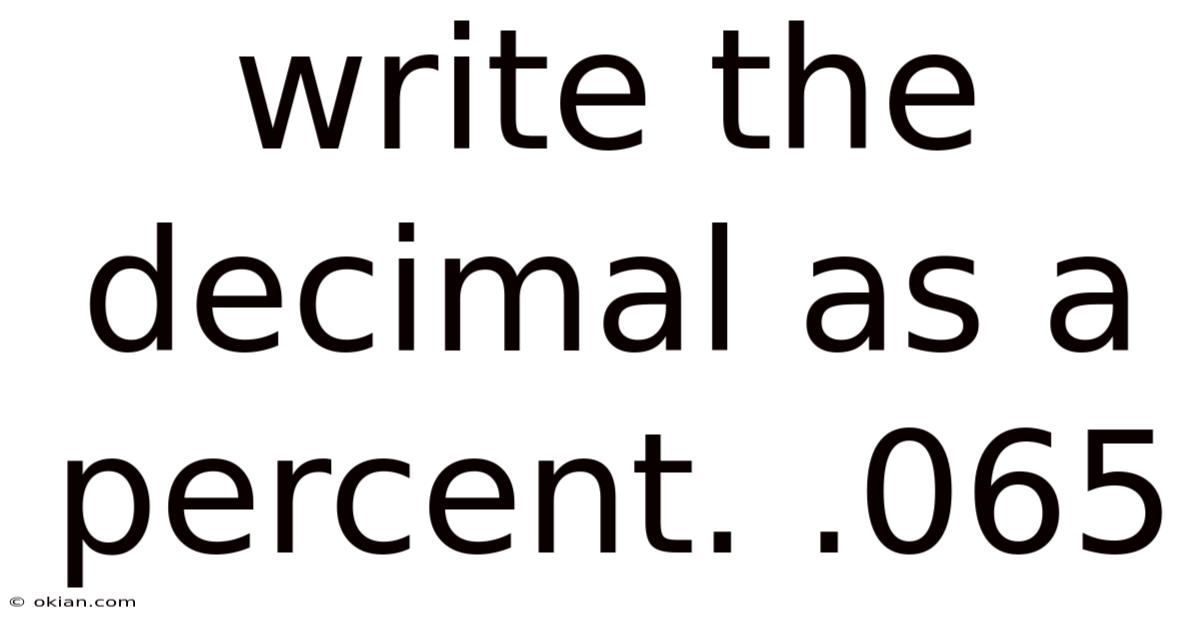
Understanding How to Write a Decimal as a Percent: A Complete Guide
Have you ever stared at a price tag that says "25% off" and wondered what that truly means in plain numerical terms? Or perhaps you've seen a nutrition label stating a product contains "0.065g" of a certain nutrient and questioned how that tiny decimal translates into a more intuitive percentage? The bridge between these two common numerical representations—decimals and percentages—is one of the most fundamental and practical skills in mathematics, personal finance, science, and daily life. At its heart, converting a decimal to a percent is a simple shift in perspective, transforming a number expressed as a fraction of 1 into a number expressed as a fraction of 100. This article will demystify this essential process, using the specific example of 0.065, and provide you with a comprehensive, lifelong understanding of the concept.
The Detailed Explanation: What Does "Percent" Really Mean?
The word "percent" is a direct linguistic clue to its mathematical meaning. It comes from the Latin per centum, which translates to "by the hundred" or "for each hundred." Therefore, a percentage is simply a ratio or fraction where the denominator is always 100. When we say 50%, we mean 50 out of 100, or 50/100, which simplifies to 1/2. The percent sign (%) is a symbolic shorthand for this "/100" relationship.
A decimal, on the other hand, is a way of representing fractions where the denominator is a power of 10 (10, 100, 1000, etc.). Our decimal system is base-10, so each place to the right of the decimal point represents tenths, hundredths, thousandths, and so on. For the decimal 0.065, we read it as "sixty-five thousandths." This means its fractional equivalent is 65/1000. The key to conversion lies in manipulating these two equivalent representations—the decimal and the fraction out of 100—to reveal their shared value.
The core mathematical relationship is elegantly simple: To convert any decimal to a percent, you multiply it by 100 and attach the percent sign (%). But why multiply by 100? Multiplying by 100 is the arithmetic operation that scales a number from being "out of 1" to being "out of 100." It shifts the decimal point two places to the right. This single action answers the question: "What number would this be if it were expressed as a part of one hundred instead of a part of one?"
Step-by-Step Breakdown: Converting 0.065 to a Percent
Let's walk through the precise, foolproof steps using our example decimal, 0.065.
Step 1: Identify the Decimal Value. Clearly recognize the number you are starting with. Here, it is 0.065. Note its place value: the '0' is in the tenths place, the '6' is in the hundredths place, and the '5' is in the thousandths place. This means 0.065 = 65/1000.
Step 2: Multiply by 100 (or Shift the Decimal Point). This is the pivotal step. You have two equivalent options:
- Arithmetic Method: Perform the calculation: 0.065 × 100 = 6.5.
- Decimal Shift Method: Simply move the decimal point two places to the right. Starting at 0.065, moving it past the '6' gives 00.65, and moving it past the '5' gives 006.5. The leading zeros are irrelevant, so we are left with 6.5. This method is faster and reduces calculation errors.
Step 3: Add the Percent Sign (%). Take the result from Step 2 (6.5) and append the percent symbol. This final symbol changes the interpretation of the number entirely. 6.5% is the complete, correct answer.
Therefore, 0.065 as a percent is 6.5%. It is crucial to understand what this means: 0.065 of a whole is equivalent to 6.5 parts out of 100. If you had a whole pizza (100%), 0.065 of that pizza would be a tiny sliver—precisely the same size as a slice that is 6.5% of the whole pizza.
Real-World Examples: Where This Conversion Matters
This conversion is not an abstract exercise; it appears constantly in practical scenarios.
- Finance and Discounts: A sales tax rate might be listed as 0.065 in a spreadsheet. To understand what you'll actually pay, you convert it: 0.065 = 6.5% sales tax. Similarly, an annual interest rate on a savings account might be 0.035, which is 3.5%.
Continuing from thepoint where the article introduced real-world examples:
- Statistics and Data Interpretation: Survey results or research findings are often reported as percentages. If a study finds that 0.12 of participants prefer a new product, converting this to a percent (0.12 * 100 = 12%) immediately tells you that 12 out of every 100 participants prefer it. This makes the data much more intuitive and comparable.
- Health and Medicine: Dosage instructions or risk assessments frequently use percentages. For instance, a medication might have a 0.025 concentration. Converting this to a percent (0.025 * 100 = 2.5%) clarifies that it represents 2.5 parts per hundred, a crucial detail for safe administration. Similarly, understanding that a patient's risk of a side effect is 0.03 (3%) helps in informed decision-making.
- Education: Grading scales and progress reports rely heavily on percentages. A student scoring 0.85 on a test translates directly to 85%, instantly conveying their performance level relative to a perfect score. This standardization is vital for assessment and communication.
- Sports and Performance: Metrics like shooting percentages in basketball (e.g., 0.452 = 45.2%) or batting averages in baseball (e.g., 0.312 = 31.2%) are fundamental statistics. Converting decimals to percentages provides a clear, standardized measure of success or efficiency that fans, analysts, and players understand instantly.
- Cooking and Recipes: Adjusting ingredient quantities often involves percentages. If a recipe requires 0.15 cups of an ingredient, converting it to 15% helps scale the recipe accurately for different serving sizes or substitutions, ensuring consistent results.
These examples underscore a universal truth: the decimal-to-percent conversion is far more than a mathematical exercise. It's a fundamental skill for interpreting the world. Whether you're calculating a discount, understanding a loan's interest rate, analyzing poll results, assessing health information, evaluating performance, or following a recipe, the ability to move seamlessly between decimals and percentages provides clarity, facilitates comparison, and enables informed decisions. It transforms abstract numbers into meaningful proportions of a whole, making complex information accessible and actionable.
Conclusion:
Mastering the conversion of decimals to percentages is essential for navigating both academic concepts and everyday life. The core principle—multiplying by 100 or shifting the decimal point two places to the right—provides a simple, reliable method to express any decimal as a part of one hundred. This skill unlocks the ability to interpret data, understand financial implications, evaluate risks, assess performance, and follow instructions accurately. From calculating sales tax to understanding medical information or analyzing sports statistics, the decimal-to-percent conversion is a powerful tool for making sense of the numerical information that constantly surrounds us. It transforms raw numbers into meaningful proportions, fostering better understanding and more informed choices.
Latest Posts
Latest Posts
-
All Or None Response Definition Psychology
Mar 28, 2026
-
What Is A Response In Biology
Mar 28, 2026
-
How To Write An Aaq Ap Psychology
Mar 28, 2026
-
How Do You Find The Critical Value In Statistics
Mar 28, 2026
-
World System Theory Ap Human Geography
Mar 28, 2026
